Protect Your Roof from Pennsylvania's Winter Damage
Roofing, Home Maintenance, Pennsylvania Weather
How Pennsylvania’s Freeze-Thaw Winters Quietly Damage Your Roof (And What to Do This Spring)
Pennsylvania’s long, icy winters can leave hidden scars on your shingles and flashing. This spring, a careful ground-level inspection—paired with a free professional assessment from RoofOps—can help you catch small issues before spring showers turn them into costly leaks.
How Freeze-Thaw Cycles Quietly Damage Shingles and Flashing
Pennsylvania’s climate routinely swings above and below freezing in late fall, winter, and early spring. When snow and ice melt during the day and refreeze overnight, water works its way into tiny gaps in your roofing system. As it freezes, it expands, slowly prying materials apart and weakening critical components such as shingles and flashing.
Shingles can curl, crack, or lose protective granules under repeated freeze-thaw stress. Even if they still appear mostly intact from a distance, microscopic fractures and lifted edges can allow water to travel underneath the shingle surface. Over time, this can saturate the underlayment and deck, setting the stage for leaks and wood rot once spring rain arrives in full force.
Flashing—the thin metal installed around chimneys, skylights, vent pipes, and along valleys—faces similar stress. Freeze-thaw cycles can loosen fasteners, open small gaps at seams, and distort the metal itself. Because flashing is designed to direct water away from vulnerable joints, even a minor separation can channel water directly into your attic or wall cavities, often without obvious signs until the damage is advanced.
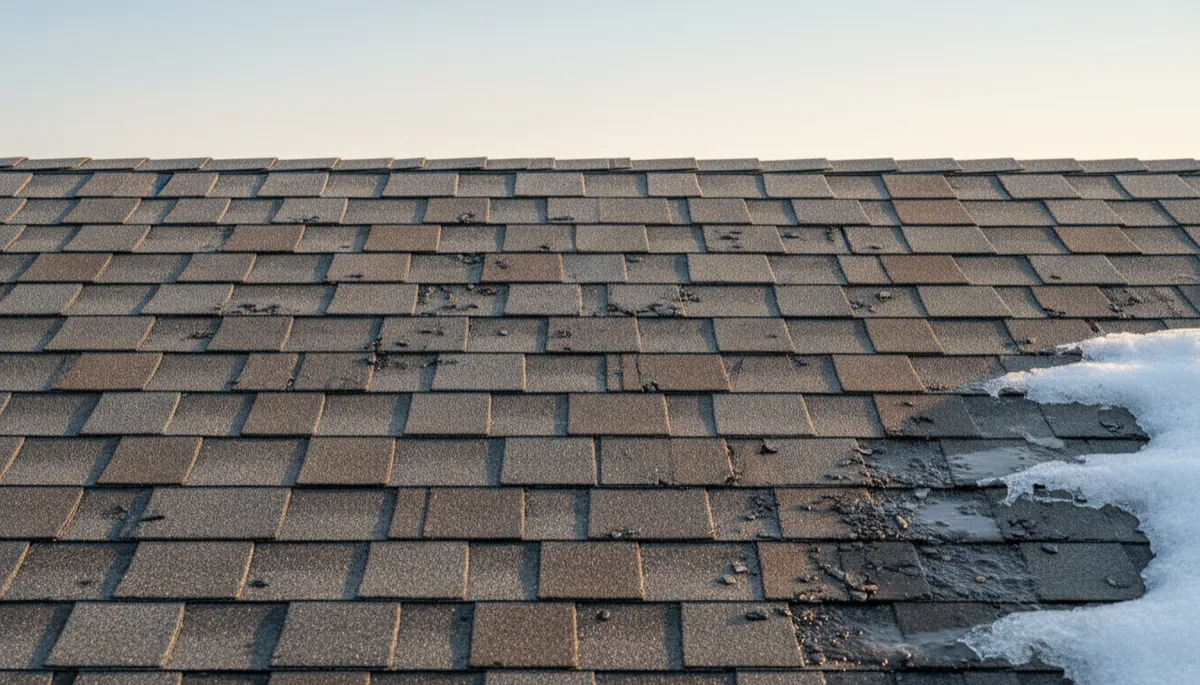
Minor shingle wear after winter can quickly escalate once spring rain exposes weak points.
Spring Roof Check: A Ground-Level Inspection Checklist for Homeowners
A full roof assessment should always be handled by a trained professional, but there is a great deal you can safely evaluate from the ground this spring. Use the checklist below as a first pass before you schedule your free RoofOps inspection. Avoid climbing on your roof or using steep ladders; your goal is to observe, not to perform repairs yourself.
Scan for missing or slipped shingles. Step back far enough to see the entire roof surface. Look for dark patches, uneven lines, or spots where the pattern of shingles appears disrupted.
Check for curling, cupping, or cracked shingle edges. Use binoculars if available to spot edges lifting, corners turned upward, or visible cracks—especially on sun-facing slopes.
Look for excessive granules in gutters and downspout outlets. Piles of coarse, sand-like material around downspouts can indicate that your shingles lost protective granules during winter storms and freeze-thaw cycles.
Inspect flashing areas from the ground. Focus on chimneys, skylights, roof valleys, and where rooflines meet walls. Look for rust, gaps, lifted sections, or sealant that appears cracked or missing.
Check for sagging or uneven roof lines. Any dip or wave in the roof deck may signal moisture intrusion or structural stress beneath the shingles, often made worse by ice and snow loads.
Walk your home’s interior. In the top floor and attic, look for water stains, peeling paint, damp insulation, or a musty odor that might point to slow leaks developing over winter.
Review your gutters and downspouts. From the ground, confirm that gutters are attached firmly, not pulling away, and that downspouts are directing water away from your foundation to prevent overflow along the roof edge.
⚠️ Safety Reminder: If you cannot clearly see a section of your roof from the ground, do not attempt to climb onto it. Make a note and share it with your RoofOps inspector instead.

Ground-level inspections help you spot concerns while leaving detailed evaluation to professionals.
Why a Free RoofOps Inspection Is the Safest Way to Prepare for Spring Showers
While a homeowner’s visual check is an important first step, many forms of freeze-thaw damage are subtle and easy to miss without specialized training. RoofOps inspectors are experienced with Pennsylvania’s unique weather patterns and know exactly where winter stress tends to reveal itself first—around nail heads, under lifted shingles, and at vulnerable flashing transitions.
A Roof Maintenance visit from RoofOps includes a thorough, hands-on inspection that goes far beyond what is visible from your yard. Inspectors evaluate the condition of shingles, flashing, sealants, gutters, and roof penetrations, documenting any areas of concern and explaining your options clearly. Because the inspection is free, you gain professional insight without obligation, allowing you to prioritize any recommended repairs before heavier spring storms arrive.
Safety is another key reason to involve RoofOps. Climbing onto a roof—even one that appears dry—can be hazardous, especially after a long winter of moisture, algae growth, and potential structural weakening. By relying on a trained, properly equipped team, you avoid the risk of falls and ensure that any fragile areas are identified without causing additional damage.
Once your inspection is complete, RoofOps can provide a detailed action plan and a Free Estimate for any recommended work. Addressing minor winter damage now is far more cost-effective than dealing with emergency repairs after a heavy spring downpour exposes a hidden leak.

Professional inspections turn hidden winter damage into clear, actionable information for homeowners.
Aligning With Spring Storm Preparedness Guidance
National guidance on seasonal weather risks reinforces the importance of a sound roof before storm season. The Federal Emergency Management Agency (FEMA) emphasizes that maintaining your home’s exterior, including the roof, is a critical part of preparing for severe weather and reducing potential damage. In Pennsylvania, where heavy spring rains often follow a harsh winter, this preparation is especially important.
By combining your own ground-level inspection with a comprehensive, no-cost evaluation from RoofOps, you create a proactive plan that aligns with these best practices. You are not only protecting your shingles and flashing—you are safeguarding your attic, insulation, walls, and ultimately the comfort and value of your home.
📌 Key Takeaway: Freeze-thaw damage is often invisible from the ground, but its consequences are not. Schedule your RoofOps free inspection now so your roof is ready for the next round of Pennsylvania spring storms.
